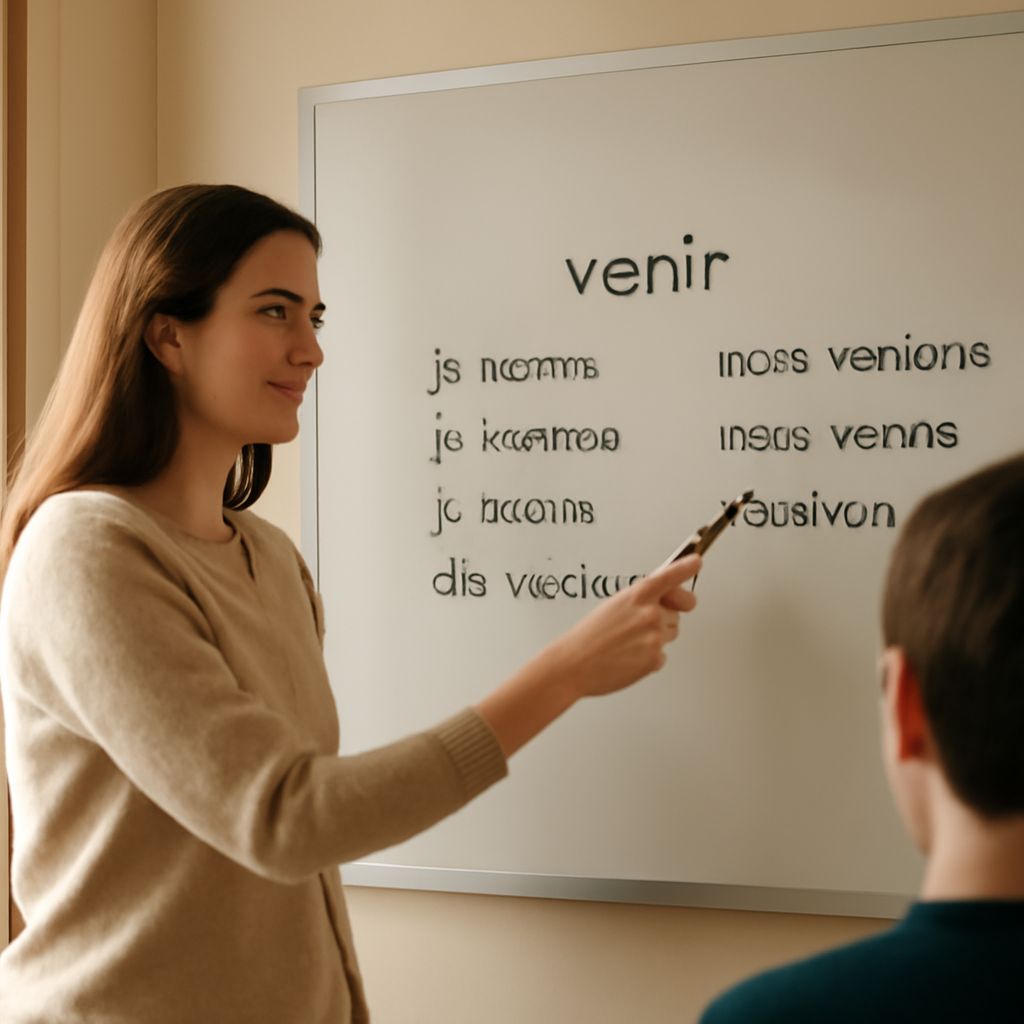
Mastering the French language involves understanding various tenses and moods, and the venir present tense is a crucial starting point. As learners progress, they encounter the intricate nuances of the venir present subjunctive, a mood used for expressions of doubt, desire, and emotion. This journey is facilitated by comprehensive venir charts, which provide an essential roadmap for all levels of learners. In this guide, the focus will be on demystifying the venir subjunctive to bolster French conjugation skills, using practical examples and detailed explanations.
Understanding the venir present tense
Basic rules of venir present tense
The venir present tense is foundational in learning French conjugation. It outlines how the verb ‘venir,’ which means ‘to come,’ is used in its simplest form. This tense is primarily used to describe actions that occur in the present moment.
In the present tense, ‘venir’ is conjugated as follows: je viens, tu viens, il/elle vient, nous venons, vous venez, ils/elles viennent. Mastery of this form ensures a solid foundation for moving into more complex tenses and moods.
Examples of venir in present tense
To better understand, here are examples of ‘venir’ in the present tense:
- Je viens de Paris. (I come from Paris.)
- Nous venons chaque semaine. (We come every week.)
- Ils viennent toujours à l’heure. (They always come on time.)
Exploring the venir subjunctive
When to use venir subjunctive
The subjunctive mood, encompassing the venir present subjunctive, is employed to express uncertainty, wishes, or hypothetical situations. It is not as frequently used as the indicative mood, but understanding its application is essential for advanced proficiency.
The subjunctive is often triggered in clauses following verbs of doubt, desire, necessity, or possibility. For example, “Il faut que je vienne” (I must come).
Examples of venir subjunctive in sentences
Consider these sentences illustrating the use of ‘venir’ in the subjunctive mood:
- Il est possible que je vienne demain. (It is possible that I come tomorrow.)
- Je veux que tu viennes avec moi. (I want you to come with me.)
- Il est essentiel que nous venions à l’heure. (It is essential that we come on time.)
Mastering the venir present subjunctive
Differences between present tense and present subjunctive
While both the present tense and the present subjunctive use ‘venir,’ their conjugations differ. The subjunctive form includes: je vienne, tu viennes, il/elle vienne, nous venions, vous veniez, ils/elles viennent. Notice the subtle changes in the plural forms compared to the present indicative mood.
Tips for mastering the venir present subjunctive
To master the venir present subjunctive, practice is key. Regularly conjugating the verb in various contexts enhances fluency and confidence. Utilize online resources and practice exercises to reinforce understanding and application in real-world scenarios.
Comprehensive venir chart for conjugation
How to read a venir chart
A venir chart is an invaluable tool for visual learners, providing a concise overview of verb forms across different tenses and moods. Each row typically represents a pronoun and its corresponding conjugation, offering a quick reference for learners.
Using a venir chart for learning
Regular reference to a venir chart can significantly aid memorization and understanding of conjugations. It allows learners to see patterns and make connections between different verb forms, reinforcing overall language acquisition.
Conclusion and further learning
Recap of venir French conjugation
The venir present tense and the venir present subjunctive are essential components of French verb conjugation. By understanding their forms and uses, learners can express a wide range of ideas and sentiments, enhancing their communication abilities in French.
Resources for continued French learning
To continue developing French skills, explore language apps, online courses, and French literature, which provide context and depth to the learning experience. Interacting with native speakers and practicing speaking and listening are equally beneficial.
Next steps: Consistent practice with the venir present subjunctive and other verb forms will solidify understanding. Engage in daily exercises, seek feedback from proficient speakers, and immerse oneself in French media to further develop proficiency and confidence in using the French language.